 The Original Sock Monkey Sock · Since 1880
America's Most Famous Sock
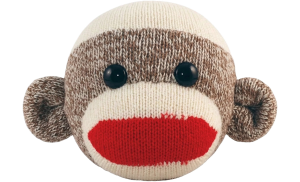
You know the sock even if you don't know the name. Brown body, red heel, and the reason every sock monkey on earth has red lips. The Rockford Red Heel has been in continuous production since 1880, making it one of the oldest sock brands in America.
Swedish immigrant John Nelson patented his sock-knitting machine in 1868 and started automatic sock production in Rockford, Illinois by 1870. On September 15, 1880, the Nelson Knitting Company was formally established, producing "Celebrated Rockford Seamless Hosiery" — socks so popular that competitors flooded the market with generic imitations just called "Rockfords."
In 1932, advertising executive Howard Monk had an idea: change the heel from white to red. The company marketed the innovation as "De-Tec-Tip" so customers could tell the real Rockford sock from the knockoffs. The red heel also gave crafters something unexpected — a ready-made mouth for the homemade sock dolls that were already being stitched together during the Great Depression. And just like that, the sock monkey was born.
The Patent Expired in 1970
The sock monkey belongs to everyone now. Go make one.
A Sock Through Time
John Nelson arrives in Rockford. A Swedish immigrant born in 1830, Nelson settles in Rockford, Illinois and works as a cabinet maker. He becomes obsessed with improving the sock-knitting process — at the time, automatic machines had to be stopped so the heel and toe could be finished by hand. (HistoryWiki)
Nelson and William Worth Burson develop a home knitting machine. Patents follow in 1868, 1870 (US 108,003), and 1875. By 1871, Burson and Nelson are producing 80 pairs of socks a day.
The seamless sock is born. Burson and Nelson create the "flat machine" that closes the heel and toe automatically — the first truly seamless sock. No more uncomfortable seams. This is the innovation that puts Rockford on the map.
Nelson Knitting Company is formally established on September 15th, producing "Celebrated Rockford Seamless Hosiery." The socks are so popular that competitors flood the market with generic imitations called "Rockfords." (Sock Monkey Museum)
Production reaches 450 dozen pairs daily. By 1930, that number hits 686,218 dozen pairs of work socks per year. By 1938, the factory is producing 4,000 dozen pairs a day — one pair every four and a half minutes.
The red heel is born. Rockford advertising exec Howard Monk suggests changing the heel color from white to red. Nelson Knitting markets it as "De-Tec-Tip" so customers can spot genuine Rockford socks. During the Great Depression, families discover the red heel makes a perfect mouth for homemade sock dolls stuffed with sawdust, rice, or foam. (Wikipedia)
The great sock monkey patent fight. Aurora, IL resident Helen Cooke receives design patent D170,008 for a "Cooke doll" — the sock monkey. She sues Stanley Levy for selling his own version. Levy contacts Nelson Knitting, who digs up evidence of earlier designs — including one by Grace Wingent of Rockford from February 1951, made as a Valentine's gift for her grandson. Cooke settles, selling her patent to Nelson for $750. (Midstory)
Nelson Knitting wins the sock monkey patent (D170,008) and starts packaging illustrated instructions for making the "Sensational Monkey Toy" with every pair of Red Heel socks. They also become the first sock company to stitch team names and insignias onto socks.
The sock monkey patent expires. The sock monkey now belongs to everyone.
Nelson Knitting closes its doors after 112 years, citing excessive labor and yarn costs. Fox River Mills of Osage, Iowa — America's oldest sock brand (est. 1900) — acquires the Red Heel trademark and patents.
Nester Hosiery acquires Fox River's assets, including the Original Rockford Red Heel brand. The sock monkey sock finds a new home in Mount Airy, North Carolina — still American-made, still the same iconic sock.
Get Your Own


Make Your Own Sock Monkey
One sock becomes the body and legs. The other becomes the arms, mouth, tail, and ears. The red heel is what gives every sock monkey its trademark lips. Fox River has a detailed photo guide that walks you through the whole thing step by step.
Download Instructions (PDF) ➔Sock Monkey Stuff
Helen Cooke received design patent D170,008 for the sock monkey in 1953, but Nelson Knitting proved earlier designs existed — including one by Grace Wingent from February 1951, a Valentine's gift for her grandson. Cooke sold her patent for $750.
The red heel wasn't originally about monkeys at all. It was a trademark called "De-Tec-Tip" so customers could spot genuine Rockford socks from cheap imitations. The crafting use was pure luck.
Every March, Midway Village Museum in Rockford hosts Sock Monkey Madness — now in its 20th year. They have a seven-foot sock monkey named Nelson.
From John Nelson's first machine in 1868 to the socks you can buy today, the Rockford Red Heel has never left the United States. 87% cotton, American equipment, American materials.